
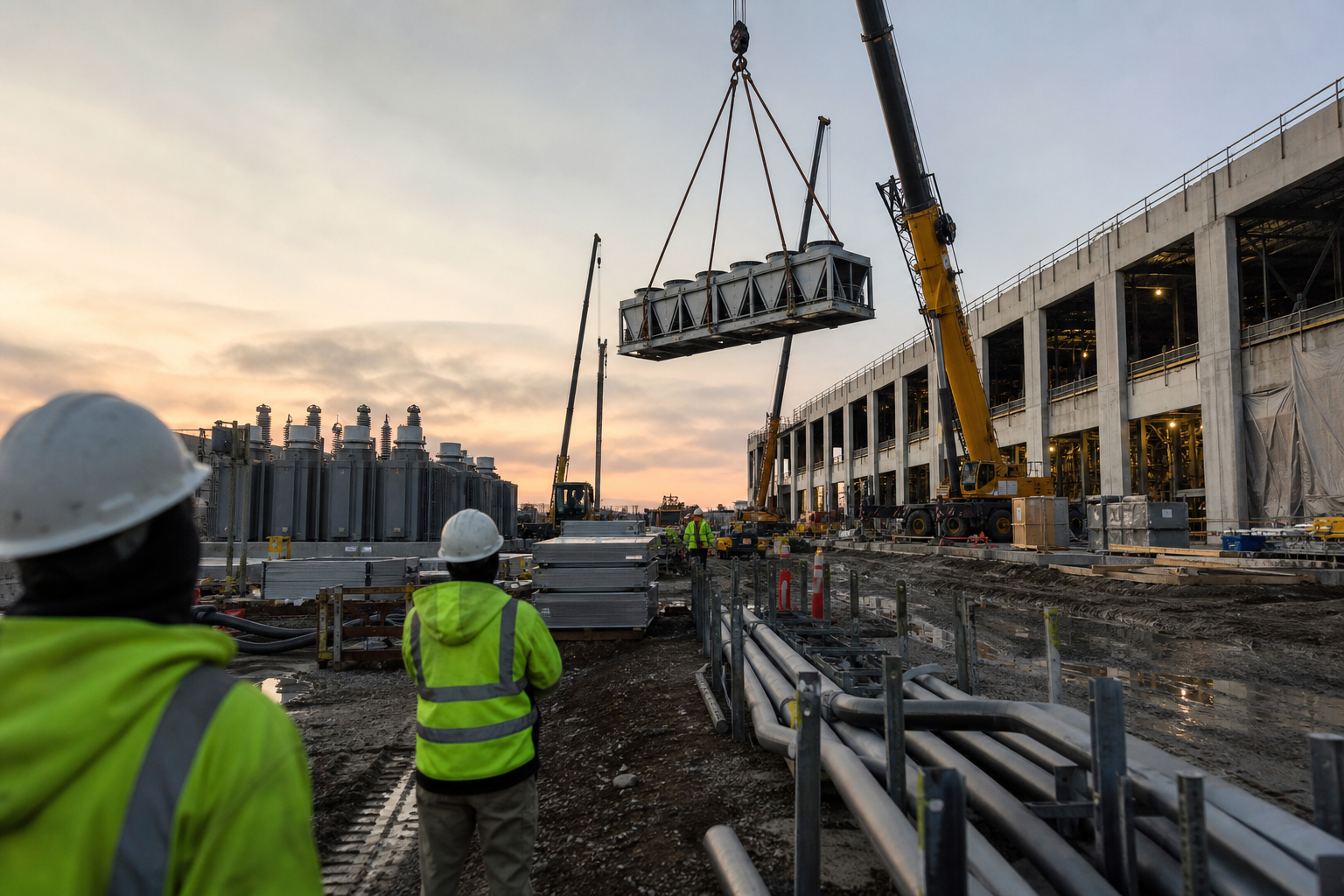
Big Tech has spent years looking like the sturdy engine room of the US stock market: powerful, profitable and capable of generating dependable free cash flow. Now artificial intelligence is sending that engine into a much more demanding gear, as hyperscalers commit hundreds of billions of dollars annually to data centers, GPUs and related infrastructure.
The wager is straightforward but consequential. If AI revenue growth keeps pace, the spending may look like the price of building a new computing platform. If it does not, investors may begin asking whether the companies that helped define financial efficiency have started to sacrifice cash generation for scale. That question could reach well beyond individual stocks, touching valuations, index concentration and the durability of the AI-led rally in US equities.
That is the emerging concern identified in CNBC’s analysis of Big Tech’s AI buildout: infrastructure spending is putting a longtime financial strength to the test. The issue is not whether artificial intelligence matters. The market has already made its enthusiasm clear. The issue is whether capital spending is moving faster than the cash flows needed to justify it.
Free cash flow has been part of the investment story
For investors, free cash flow has historically been a central reason to favor Microsoft ($MSFT), Alphabet ($GOOGL), Meta Platforms ($META) and Amazon ($AMZN). These companies have not been viewed merely as businesses with attractive products or large user bases. Their appeal has also rested on the ability to generate cash after funding operations and capital expenditures.
That cash provides strategic flexibility. It can support continued investment, strengthen balance-sheet resilience and give management room to respond as technology cycles change. It also helps explain why these companies have occupied such influential positions in growth-oriented portfolios and major US equity indexes.
AI infrastructure complicates that familiar picture. Data centers, GPUs and related systems require substantial upfront commitments. The more aggressively the hyperscalers build, the more capital is tied up before the resulting services and revenue streams fully mature. The accounting may not immediately capture the economic strain investors are watching for, but free cash flow can offer a sharper lens on the trade-off.
The danger is a timing mismatch
The central risk is not necessarily that AI demand disappears. It is that AI revenue growth could lag the pace of spending commitments. In that scenario, the companies may still be expanding their technical capabilities while producing less free cash flow than investors have come to expect.
That mismatch could also pressure returns on invested capital. A large infrastructure program needs more than impressive adoption headlines; it needs enough economic output to make the investment productive over time. If the revenue payoff arrives later than expected, or if competition pushes prices and margins lower, the financial return on the buildout could look less compelling.
This is where valuation enters the conversation. Investors often assign greater importance to future growth when a company has both expanding opportunities and strong cash generation. If the cash-generation side becomes less dependable, the market may scrutinize growth assumptions more closely. That does not dictate a single outcome for any one stock, but it could make the group more sensitive to evidence of capital discipline—or the lack of it.
Why the indexes matter
The stakes are amplified by concentration. When a small group of very large technology companies carries substantial influence in broad US equity benchmarks, questions about their spending can become questions about index-level momentum. Growth funds may also face a similar tension: the companies driving the AI narrative are often central to the positioning that has benefited from that narrative.
Thursday offered a reminder of how quickly optimism can travel through the market. The S&P 500 and Nasdaq 100 rose nearly 1%, partly on AI enthusiasm following Nvidia’s strong results. The move shows the rally’s appeal, but it also highlights its dependency on expectations. If investors begin to question whether Big Tech can convert AI demand into cash at the pace implied by its infrastructure commitments, enthusiasm could become more selective.
That would not automatically end the AI investment cycle. It could, however, change the market’s preferred evidence. Announcements about capacity and computing power may receive less attention than free-cash-flow trends, spending discipline and signs that invested capital is producing durable returns.
The market’s next test
For $MSFT, $GOOGL, $META and $AMZN, the challenge is to prove that the AI arms race can strengthen—not weaken—the financial qualities that made them market leaders. Their spending may be necessary to compete, but necessity does not erase the question of economic payback.
Investors are therefore watching a balancing act: build enough infrastructure to capture AI growth, while preserving the dependable cash generation that helped support the companies’ standing in portfolios and indexes. The AI-led rally can continue if confidence in that balance holds. If confidence fades, capital allocation may become the market’s loudest technology story.
Bull/Bear Verdict
Bull Case: If AI revenue growth keeps pace with the hundreds of billions of dollars in annual infrastructure commitments described by CNBC, the spending could reinforce the long-term growth outlook for $MSFT, $GOOGL, $META and $AMZN while supporting continued index momentum.
Bear Case: If AI revenue lags spending, free cash flow and returns on invested capital could face pressure, giving investors reason to reassess capital discipline, growth-fund positioning and the nearly 1% index advance seen Thursday.