
Fed Likely to Hold Rates as Iran Conflict Clouds Policy Debate
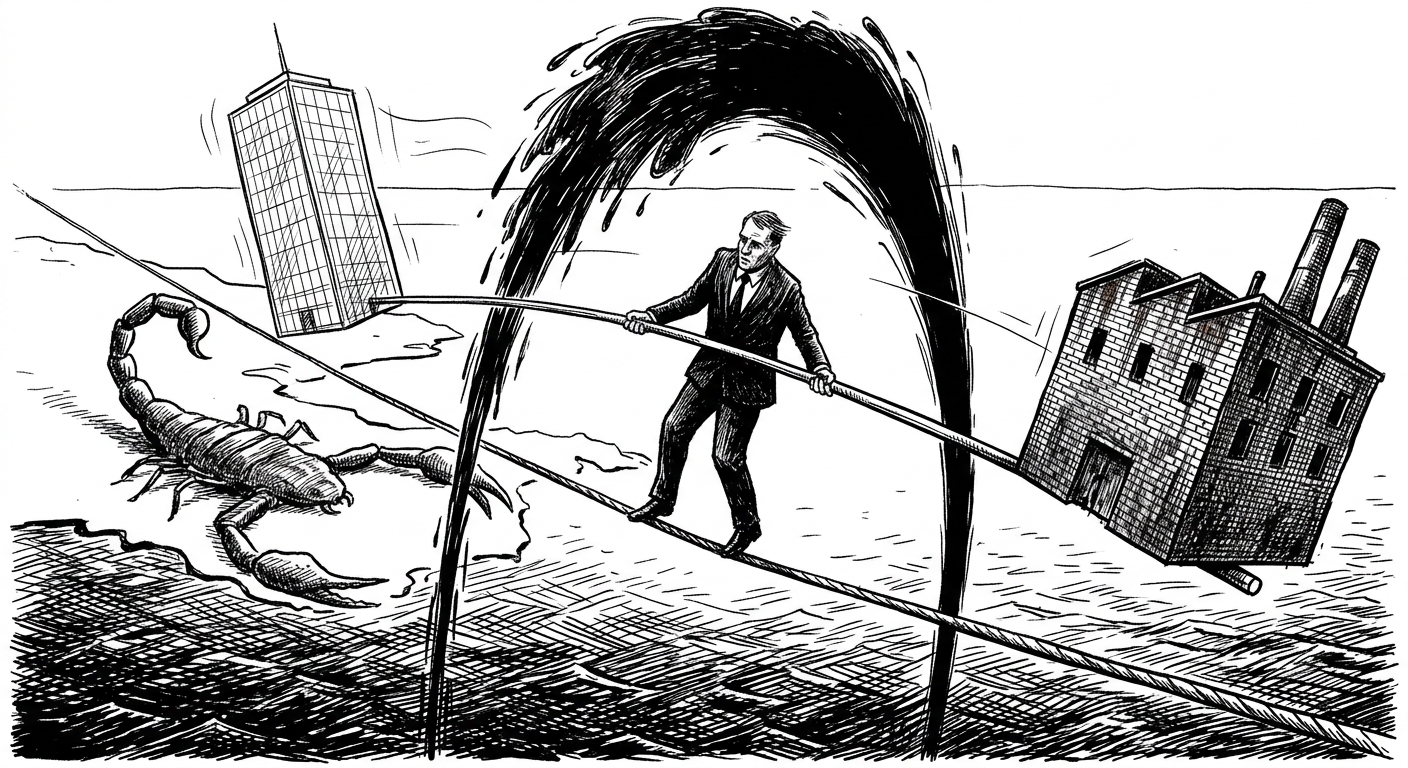
The Federal Reserve appears set to lean against new moves at its next meeting. Market pricing — built into fed-funds futures and options — now heavily favors a pause, reflecting elevated geopolitical risk after the Iran conflict and an oil spike above $100 per barrel. For the long-term investor, this is a reminder that macro and geopolitical shocks often shape policy windows more than a single data print.
How markets are pricing the decision
Late-cycle central banks typically react to a mix of inflation, growth and risk. Today the bet is on a hold: market-implied probabilities have moved decisively toward a pause, with roughly an 80–90% chance priced for no change at the upcoming Fed decision, and only modest odds assigned to a 25bp hike or an early cut. That reflects investor preference for stability while the implications of the Middle East flare-up are assessed.
Why Iran matters to the Fed's calculus
Geopolitical risk changes the Fed's assessment in two ways. First, it raises the near-term upside risk to headline inflation through energy and risk-premium channels. Second, it increases downside risk to growth by weighing on business confidence, trade routes and financial market liquidity. In practice that means the Fed must weigh higher gasoline and diesel prices against the potential for demand destruction and softer hiring — an unfamiliar balancing act when headline CPI already sits above pre-pandemic norms.
As Buffett reminds investors, the market is a device for transferring money from the impatient to the patient. Policy shocks reward calm positioning more than frantic trading.
Oil above $100: transmission to inflation and corporate margins
Crude (WTI near $105/bbl) is the clearest transmission mechanism. Energy costs feed directly into CPI via gasoline and transport components; they also filter through producer prices and raise input costs for many firms. On the consumer side, higher pump prices reduce discretionary spending, pressuring retailers and some services. For corporates, higher fuel costs compress margins for sectors that can't pass costs through — think airlines and parts of consumer discretionary — while benefiting integrated energy names.
Policy communications could shift toward caution
With heightened geopolitical uncertainty, the Fed may lean on conditional language. Expect forward guidance that emphasizes data dependence and geopolitical risk rather than firm commitments on the timing of cuts. That subtle pivot — downgrading confidence in a quick disinflation narrative — can keep rates higher for longer in market pricing without an actual hike.
Market reactions to expect
- Equities: Growth names (large-cap tech such as $AAPL, $NVDA) are often more sensitive to discount rates; a hold with lower yields can be supportive but if risk aversion rises, cyclicals and defensives may outperform. Value and commodity-linked names (energy: $XOM, $SU.TO; ETFs: $XLE) tend to benefit from higher oil.
- U.S. dollar and yields: A risk-off tilt often lifts the dollar and pushes Treasury yields lower; the 10-year yield around 4.0% may see downward pressure if investors flock to safe havens.
- Sectors: Financials ($JPM, $BAC) face mixed signals — a flatter yield curve narrows NII prospects, while stability in rates reduces immediate credit shock risk. Defensives (healthcare $JNJ / $PFE, staples $PG, $KO) typically outperform in uncertain times.
Practical implications for traders and investors
- Portfolio positioning: Trim duration risk if you’re short-term focused, but long-term investors should resist market-timing. Consider adding real-asset exposure (energy equities $XOM, Canadian names $ENB.TO, $SU.TO) and quality defensives.
- Hedging: Use modest equity protection (put collars or S&P put hedges), consider tactical exposure to gold ($GLD) and short-duration government bills to preserve optionality.
- Watch the language: If the Fed’s statement emphasizes geopolitical downside risk, expect markets to favor safe-haven and income-focused allocations over yield-sensitive growth bets.
The takeaway for the patient investor: a Fed hold in the near term, driven by geopolitical uncertainty and an oil shock, favors thoughtful rebalancing rather than headline-driven moves. Keep a multi-year lens — remember that cycles end, commodity shocks fade, and disciplined allocation wins over time.