
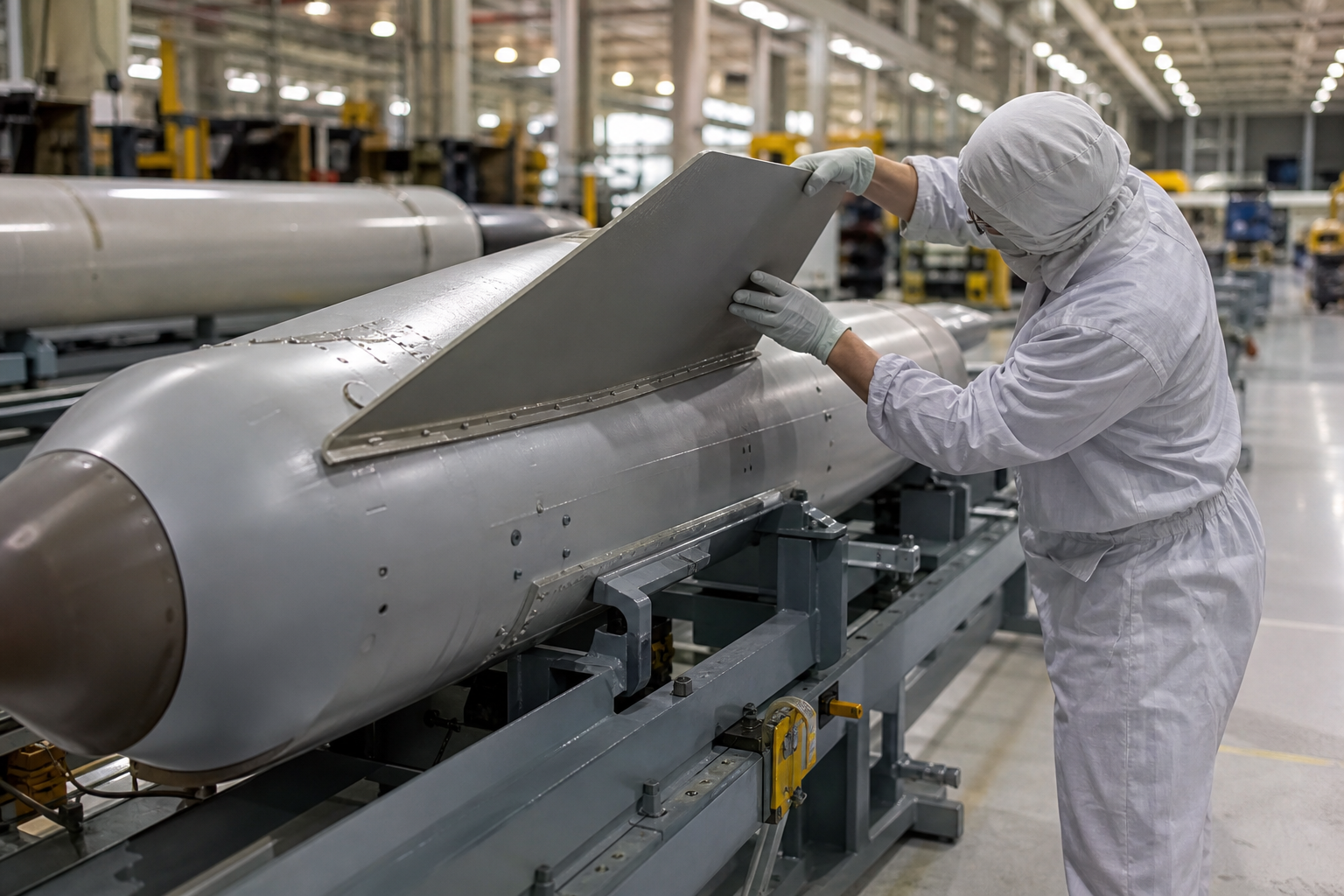
Defense spending rarely arrives with a quiet knock. It tends to come through the front door carrying a nine-figure price tag, and Lockheed Martin’s latest U.S. Army award is no exception: the company won a missile contract valued at up to $1.2 billion.
For investors watching $LMT, the award offers a fresh data point in a market increasingly shaped by procurement decisions and geopolitical strain. It does not, by itself, establish a change in revenue, earnings, backlog or share-price performance. But its size may help keep Lockheed Martin and the broader defense sector in the conversation as Washington responds to a more unsettled security backdrop.
According to Reuters, the U.S. Army contract could be worth as much as $1.2 billion. That wording matters. “Up to” describes the potential ceiling of the award, not a confirmation that the full amount has already become recognized business for Lockheed Martin. Investors may therefore view the contract as a meaningful procurement signal while avoiding the leap from contract value to immediate financial results.
Why the award matters
A contract of this scale may indicate that missile procurement remains a significant priority for the U.S. Army. For Lockheed Martin, the award reinforces the company’s role as a major defense supplier and gives the market another concrete example of government demand for missile systems.
The investment significance is less about a single headline number than about what it may represent in the procurement pipeline. Large awards can draw attention to the durability of defense demand, particularly when military requirements are being reassessed against a tense international landscape. Still, the confirmed fact here is the contract’s potential value—not a disclosed impact on $LMT’s revenue, earnings or backlog.
Geopolitics keeps the spotlight trained on defense
The procurement backdrop is being viewed against heightened tensions involving Iran and the ongoing conflict in Ukraine. Those developments form part of the broader context for discussions about military readiness and defense spending, but they should not be treated as proof that additional contracts will follow or that any particular company’s financial performance will change.
Iran-U.S. tensions also gained a sharper economic edge. CNBC reported that Treasury Secretary Scott Bessent announced all Iranian airlines will be shut down from Wednesday. The announcement adds another layer to the confrontation, linking geopolitical pressure with measures affecting transportation and commerce. As CNBC reported, the development is part of the wider Iran-U.S. tensions context surrounding markets.
For defense investors, the message is consequential but incomplete. A more strained security environment may keep aerospace and defense stocks in focus, while actual investment conclusions still depend on contract execution, timing and future disclosures. The $1.2 billion figure is a headline-sized marker; it is not a forecast.
What investors may monitor next
After the announcement, investors may monitor $LMT for further company disclosures about the Army award, including its scope, timing and any clarification of the contract’s potential value. They may also watch whether the broader procurement backdrop produces additional confirmed awards or policy developments.
That distinction—between what is signed, what is possible and what is merely anticipated—is the guardrail around this story. Lockheed Martin has secured an Army missile contract valued at up to $1.2 billion. The geopolitical context may support continued attention to defense procurement, but the available information does not establish a direct financial outcome for the company.
Bull/Bear Verdict
Bull Case: The U.S. Army’s contract valued at up to $1.2 billion may reinforce the case for sustained defense-procurement attention, while Iran-U.S. tensions and the conflict in Ukraine could keep $LMT in focus.
Bear Case: The award is stated as worth up to $1.2 billion, so the full amount is not confirmed as realized business; the available details also do not establish an effect on $LMT’s revenue, earnings, backlog or stock price.