
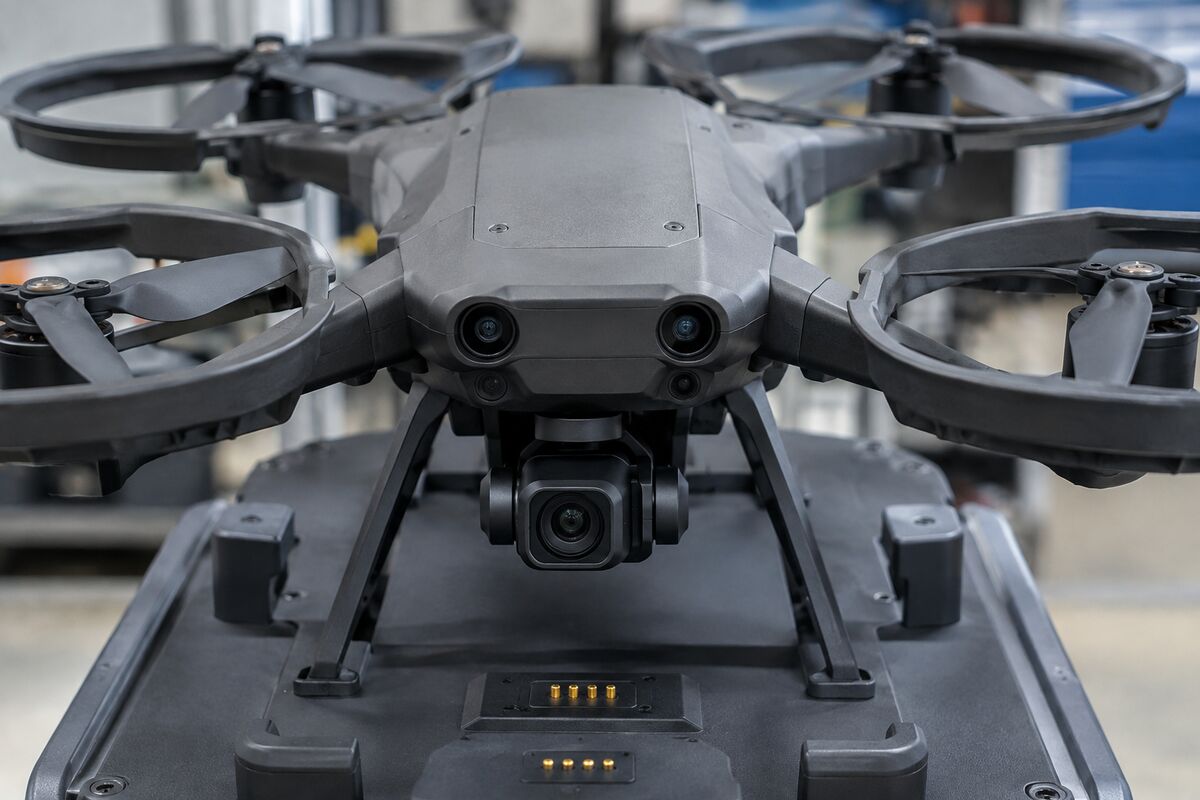
Powerus has moved from private-market promise to public-market scrutiny. Following its completed merger with Aureus Greenway Holdings, the US defense-technology company began trading on Nasdaq under the ticker $PUSA on October 1, placing autonomous drones and unmanned systems directly in front of public-market traders.
The debut brings the familiar theater of a listing-day launch—but without the comfort of a long trading history. Powerus rang the Nasdaq opening bell as the combined company began trading, creating a fresh test of how investors respond when a defense-technology story first meets the market’s real-time price discovery.
According to the company announcement published through GlobeNewswire, Powerus completed its merger with Aureus Greenway Holdings and began trading on Nasdaq as $PUSA. The already-listed Aureus Greenway Holdings renamed itself Powerus Corporation, while the opening-bell ceremony gave the corporate milestone a highly visible market debut.
What the merger changes
For traders, the key mechanical point is straightforward: the merger has now resulted in a public company trading under Powerus’s Nasdaq ticker. That means $PUSA becomes the market identifier for the combined business, rather than a private-company name existing outside the daily exchange routine.
The listing does not, by itself, provide a complete picture of the company’s valuation, revenue, contracts or operating performance. None of those figures were included in the announcement. Instead, the immediate story is the transition into public trading and the attention that may follow a new exchange listing in a closely watched technology theme.
A new ticker, a new trading test
Newly listed names often give traders a moving target: early volume, bid-and-ask liquidity and price volatility can become central points of attention as the market establishes a trading range. For $PUSA, observers may monitor whether activity builds, how consistently shares trade and whether volatility remains elevated as investors digest the merger and the company’s defense-technology focus.
That is a framework for observation—not a prediction. Whether $PUSA rises, falls or breaks out on its first session is for the market to decide.
The autonomous-drone angle
Powerus’s focus on autonomous drones and unmanned systems places the listing within a defense-technology theme that may attract investor interest. The market may pay attention to the company because autonomous systems are a prominent area of technological development, but the announcement does not establish contracts, revenue or operating results.
In other words, $PUSA arrives with a clear thematic identity but a limited public-market record. The first chapter is about the mechanics of becoming public—and how the market chooses to trade that story.
Further reading on Powerus $PUSA stock: the shares closed at $2.06 on October 16, 2026, down 46.9% from $3.88 on September 30, the last session before the merger closed. Powerus PUSA stock after the merger walks through the daily closes, the volume and the drone-stock selloff around it. For what the $82 million order is worth next to first-half 2026 revenue of $5.67 million, and the share count, warrants and $250 million shelf, see what the $82M order really means.
Correction, October 19, 2026: An earlier version of this article described Powerus as a new Nasdaq listing. Powerus combined with Aureus Greenway Holdings, which has been listed on Nasdaq since February 2025 and changed its ticker from AGH to PUSA effective May 15, 2026; the company renamed itself Powerus Corporation when the merger closed on October 1, 2026. The article has been updated.
Bull/Bear Verdict
Bull Case: The completed merger and Nasdaq listing give Powerus a public-market platform, while its focus on autonomous drones and unmanned systems may draw attention to $PUSA.
Bear Case: As a newly combined company with no supplied price, volume, valuation, revenue or contract data, $PUSA may face uncertainty and elevated volatility while the market establishes liquidity and a trading range.