
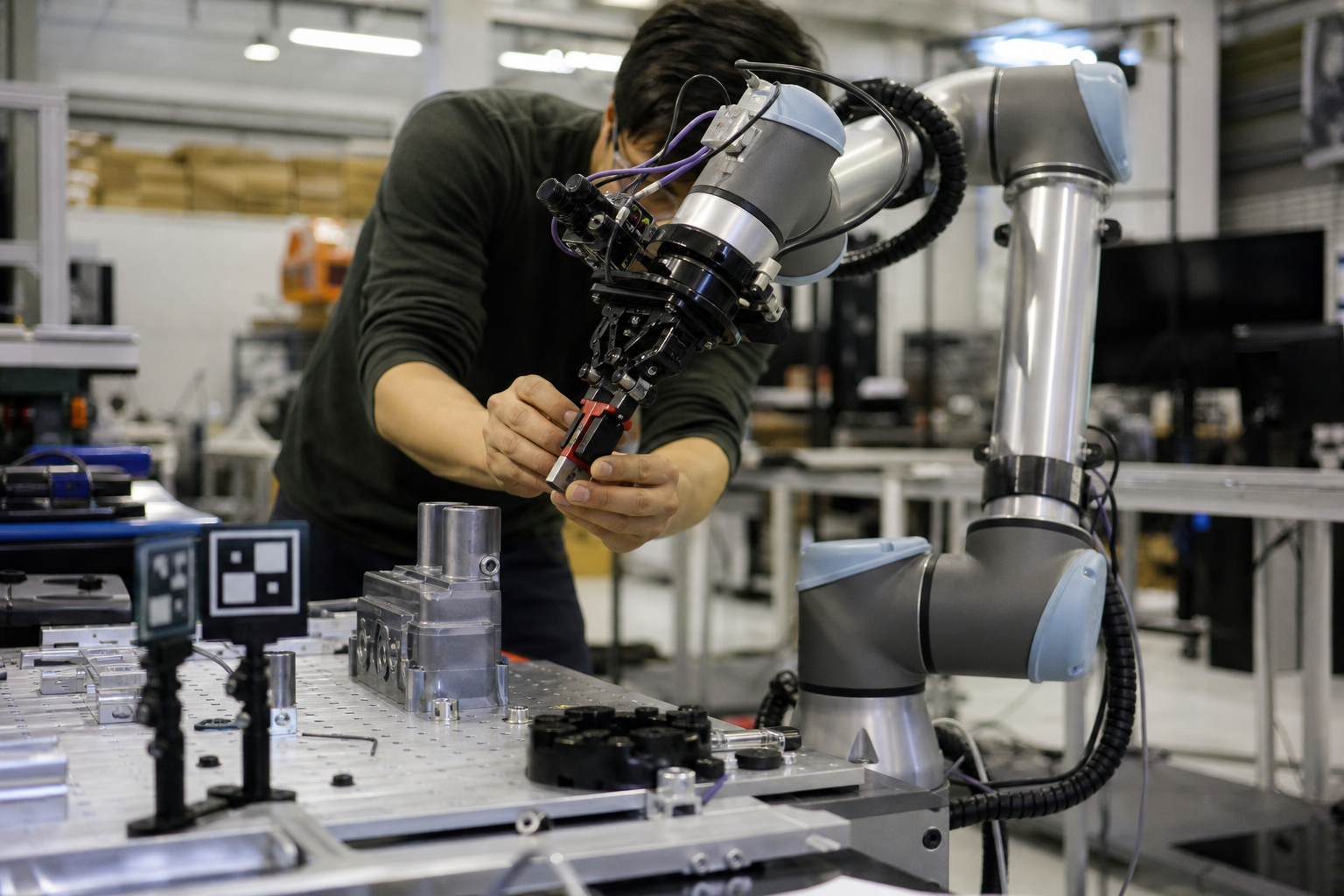
Qualcomm is making a strategic bet that its next growth narrative will be built on more than smartphones. The Nasdaq-listed semiconductor company, trading under the ticker $QCOM, has announced the acquisition of robotics software firm PickNik—a move that expands its footprint in robotics and autonomous-systems software.
The transaction does not come with disclosed financial terms, but its strategic message is clear. Qualcomm is seeking to broaden its exposure beyond traditional mobile-semiconductor markets, and PickNik gives that effort a more direct connection to the software layer supporting advanced machines.
As reported by Seeking Alpha, Qualcomm announced the acquisition of PickNik. The announcement provides no purchase price and does not quantify expected synergies. Those omissions matter: the deal’s strategic logic can be evaluated, but its immediate financial contribution cannot be measured from the disclosed information.
A step beyond mobile semiconductors
For Qualcomm, the appeal is diversification. The company’s traditional identity is closely associated with mobile semiconductors, while robotics and autonomous systems represent a different application arena with distinct software requirements. By adding PickNik, Qualcomm is expanding its presence in an area where hardware capability increasingly depends on software that can coordinate, control, and manage complex machines.
That distinction is important. Robotics is not simply another chip market. Successful autonomous systems require an integrated technology stack, with computing hardware and software working together. A stronger software position could help Qualcomm present itself as a broader platform company rather than a supplier defined primarily by mobile devices.
Why robotics software matters
AI-driven robotics and autonomous systems are becoming important competitive areas for semiconductor and software companies because intelligent machines require both processing power and sophisticated software. Hardware can provide the computational foundation, but software helps determine how that capability is deployed in real-world systems.
PickNik’s role in this transaction is therefore strategically relevant even without disclosed financial details. The acquisition expands Qualcomm’s exposure to the software side of robotics, potentially supporting a more complete offering for customers developing autonomous systems. It also gives the market another data point in assessing whether Qualcomm can translate its semiconductor expertise into adjacent technology categories.
That is the bullish interpretation. The more cautious view is that strategic adjacency does not automatically produce financial results. Qualcomm has announced the acquisition, but the source does not provide terms, revenue expectations, integration milestones, or quantified synergies. Until those details emerge, the transaction remains primarily a statement of direction rather than a measurable change to the company’s earnings outlook.
What the market may watch next
The near-term question is how the market reacts to the announcement. A positive response could indicate that investors view robotics and autonomous systems as credible additions to the QCOM diversification narrative. A muted response, meanwhile, could suggest that market participants want evidence of financial scale and execution before assigning greater value to the strategy.
Longer term, execution will matter more than the headline. Market participants may monitor whether Qualcomm clearly communicates PickNik’s role within its broader robotics strategy, how the software business fits with Qualcomm’s existing capabilities, and whether future disclosures establish measurable progress. Without those indicators, it would be premature to claim that the acquisition changes Qualcomm’s competitive position in a definitive way.
The larger point is that Qualcomm is attempting to widen the frame through which the market evaluates the company. Robotics and autonomous-systems software may give $QCOM a path toward a more diversified growth narrative, but that narrative still needs to be supported by execution and financial disclosure. For now, the PickNik acquisition is a strategically notable move with an intentionally incomplete financial picture.
Bull/Bear Verdict
Bull Case: The PickNik acquisition may strengthen $QCOM’s diversification narrative by expanding Qualcomm’s footprint in robotics and autonomous-systems software beyond its traditional mobile-semiconductor exposure.
Bear Case: With no financial terms, revenue expectations, or quantified synergies disclosed, the deal may not yet provide enough evidence to support a material change in Qualcomm’s near-term outlook.