
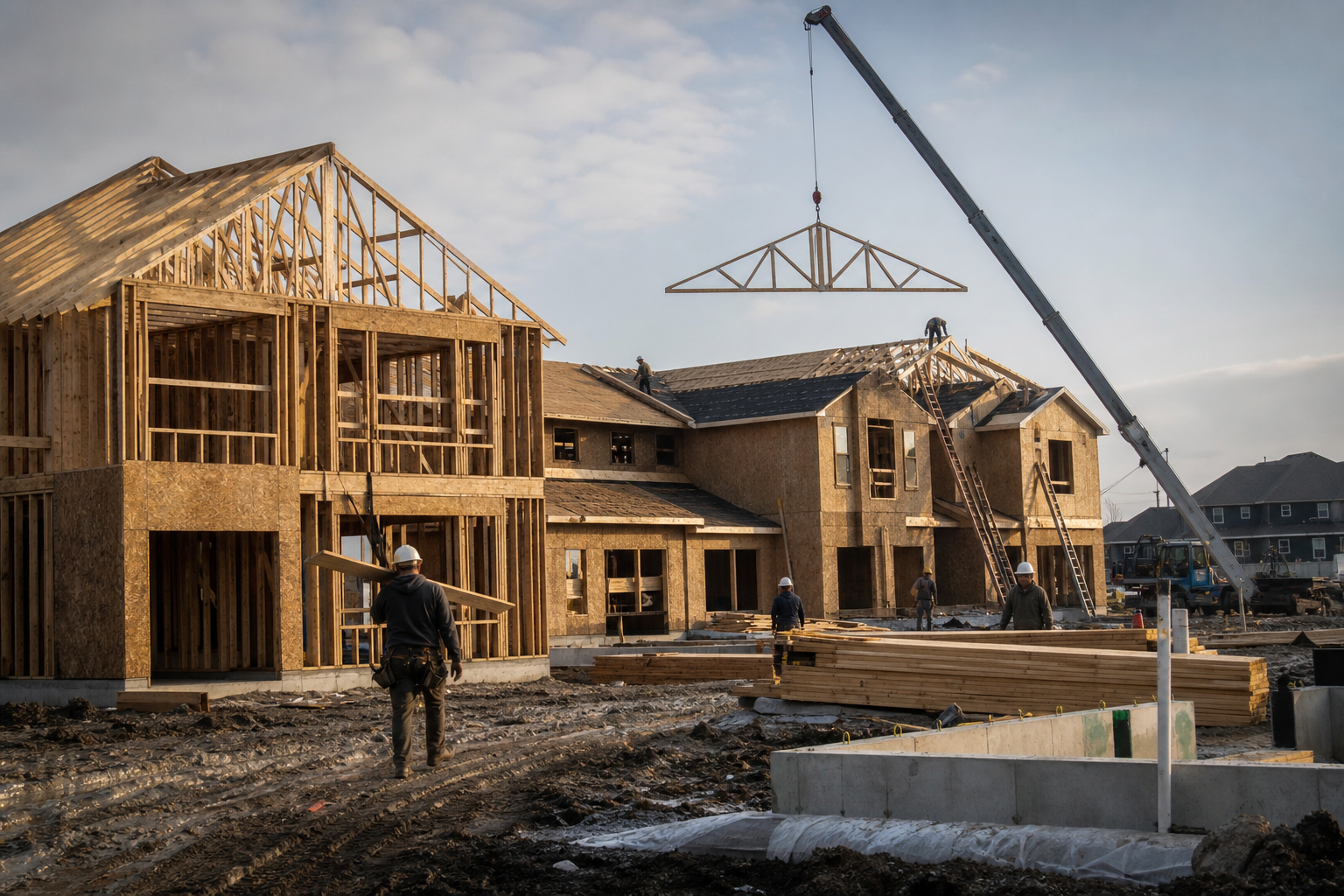
Homebuilding consolidation is stepping into the spotlight at a delicate moment for US housing. On August 7, 2026, Dream Finders Homes ($DFH) announced a $2.2 billion all-cash agreement to acquire Beazer Homes ($BZH), creating a major test of whether scale can become more attractive as mortgage rates squeeze buyers and sellers lose some pricing power.
The transaction arrives alongside a financing commitment that gives the deal another important dimension: Millrose Properties ($MRP) has committed up to $1.25 billion to support Dream Finders' acquisition. The announced deal and financing commitment are facts. What they may signal for the broader homebuilding sector is the more intriguing question—and one that investors may now ask of every major US builder.
According to the reported transaction details, Dream Finders is pursuing Beazer in an all-cash deal valued at $2.2 billion. A separate report says Millrose has committed up to $1.25 billion in support. Those figures make this more than a routine corporate reshuffling: it is a significant consolidation event in the US homebuilding sector, announced while the housing market is under visible pressure.
A deal against a softer housing backdrop
The timing matters. Homes are selling below asking price in 38 of the 50 largest US cities, according to the housing-market context accompanying the announcement, as higher mortgage rates pressure buyers. That backdrop can make the homebuilding business a tougher place to operate. Buyers may be more sensitive to monthly payments, while sellers may have less room to hold firm on price.
In that environment, an acquisition may offer a way for a buyer to pursue greater scale while conditions remain unsettled. That is an interpretation—not a disclosed rationale for Dream Finders' decision. The available information does not establish specific synergies, a valuation premium, or a guaranteed financial outcome. It does, however, put a large all-cash transaction on the table at a time when demand and pricing conditions are under strain.
Why consolidation could matter now
Homebuilding is an industry where market conditions can vary sharply by geography, product type and buyer profile. A softer national picture does not mean every local market is moving in lockstep. Still, the combination of higher mortgage rates and below-asking-price sales in many large cities creates a market backdrop in which executives may examine corporate scale, capital access and operating reach more closely.
Millrose's up-to-$1.25 billion commitment is especially important to the market narrative because it shows that the announced acquisition is accompanied by a substantial financing commitment. It does not, by itself, prove what the combined company will achieve. It does suggest that financing structure is central to how this consolidation is being assembled, rather than a footnote after the headline deal.
The central market question is not simply whether Dream Finders can buy Beazer. It is whether this transaction becomes a reference point for how US homebuilders navigate a period when housing demand and pricing are facing pressure.
The read-through for the sector
For other US-listed homebuilders, the deal may become a sector marker to monitor. D.R. Horton ($DHI), Lennar ($LEN) and PulteGroup ($PHM) are not identified as participants in this transaction, and there is no basis here to suggest that any of them is pursuing a similar deal. Their relevance is broader: the Dream Finders-Beazer agreement may prompt market watchers to compare how large builders are positioned as mortgage rates pressure buyers and homes sell below asking in many major cities.
That read-through should be handled carefully. One announced acquisition does not establish a wave of deals, nor does it settle whether consolidation will improve results in a softer housing market. But the size of the transaction, its all-cash structure and Millrose's financing commitment give investors a concrete event around which to frame that discussion.
Dream Finders' announcement therefore lands as both a corporate transaction and a market signal. The $2.2 billion price tag puts consolidation in plain view; the up-to-$1.25 billion Millrose commitment underlines the financing involved; and the housing backdrop explains why the sector may be watching closely. Whether the deal becomes a blueprint or simply a prominent exception remains an open question.
Bull/Bear Verdict
Bull Case: The $2.2 billion all-cash acquisition, supported by Millrose's commitment of up to $1.25 billion, may position this transaction as a significant consolidation event while housing conditions are under pressure.
Bear Case: Homes selling below asking price in 38 of the 50 largest US cities and higher mortgage rates may limit what consolidation can achieve, while the announced facts do not establish specific synergies or a valuation premium.