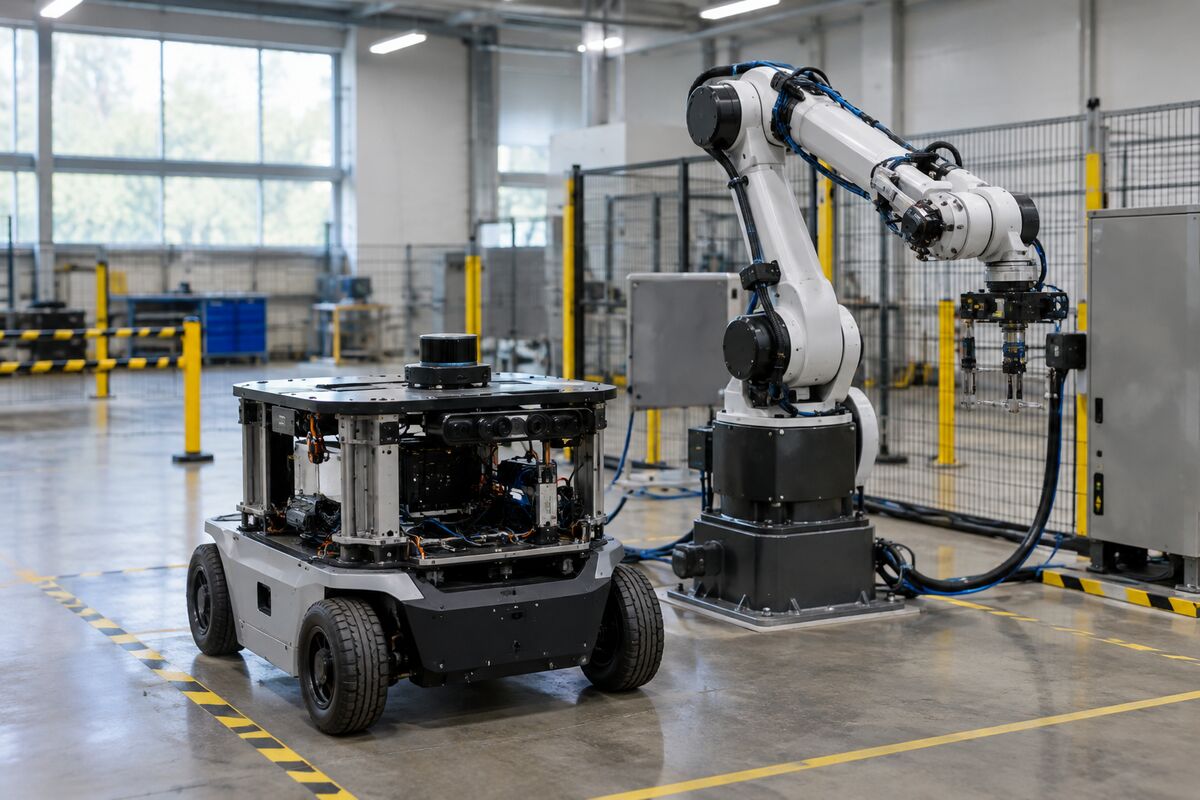
Rockwell Automation is adding another piece to its industrial automation strategy. The company has signed a definitive agreement to acquire AGILOX, an Austrian manufacturer of autonomous mobile robots, giving $ROK a broader position in a robotics segment that connects warehouse movement, factory operations and digital transformation.
The transaction, announced November 19, 2026, is strategically important because autonomous mobile robots are designed to move materials through industrial and warehouse environments without relying on fixed transport infrastructure. For Rockwell, the AGILOX agreement could extend its automation portfolio beyond software, controls and production equipment into the physical movement of goods across increasingly connected facilities.
Rockwell’s announcement identifies AGILOX as an Austrian autonomous mobile robotics manufacturer and frames the deal within the company’s broader industrial automation and digital transformation positioning.
A wider robotics footprint for $ROK
Rockwell’s acquisition thesis is straightforward: adding AGILOX may give the company a more complete offering for customers seeking to automate both production processes and internal logistics. Manufacturing automation does not stop at the production line. Materials must reach workstations, finished goods must move through facilities, and inventory must be coordinated with operating systems.
Autonomous mobile robots address that movement layer. Their strategic role is therefore different from traditional fixed automation. A fixed system can perform a repeatable task in a defined location, while mobile robotics can potentially support changing routes and workflows across a facility. That flexibility may be particularly relevant for warehouses and manufacturers managing more complex product mixes or pursuing higher levels of automation.
For Rockwell, the AGILOX agreement could make its industrial technology portfolio more connected across those use cases. The company is described as the world’s largest industrial automation and digital transformation specialist. Adding an autonomous mobile robotics business may reinforce that positioning by linking plant-floor controls, digital systems and material-handling activity more closely together.
Why warehouse and manufacturing automation matter
Warehouse and manufacturing robotics sit at the intersection of several industrial priorities. Companies are seeking greater visibility into operations, more integrated workflows and technology that can support the movement of materials with less manual intervention. Autonomous mobile robots may fit that need because they are intended to operate within dynamic industrial environments rather than perform only one stationary task.
The relevance extends across two connected markets. In warehouses, mobile robots may support the movement of inventory and goods. In manufacturing, they may help transport components or finished products between operating areas. A supplier that can participate in both settings may have more opportunities to connect its technology with customers’ broader automation programs.
That makes AGILOX strategically relevant even without disclosed purchase-price, financing, closing-timeline or earnings details. The key question is not simply whether Rockwell is adding a robotics product. It is whether the acquisition can help $ROK offer a more unified automation proposition as industrial customers evaluate AI-driven capital spending and digital transformation initiatives.
The integration question for investors
A definitive agreement marks a significant corporate step, but strategic value will depend on execution. Investors will likely focus on how AGILOX’s capabilities fit into Rockwell’s existing automation portfolio and go-to-market structure. The acquisition could be more meaningful if Rockwell can connect autonomous mobile robots with the controls, software and digital systems used by industrial customers.
Integration also matters at the customer level. Robotics purchases can involve more than hardware. Customers may require software coordination, facility-level workflow design and compatibility with existing production systems. Rockwell’s established industrial automation position may create opportunities to package AGILOX technology within broader projects, although the company still must demonstrate that the combined offering can address those requirements effectively.
Another issue is market capture. The acquisition expands Rockwell’s autonomous mobile robotics footprint, but expansion alone does not establish the pace of growth. Investors should monitor whether the company can use AGILOX to reach new customers, deepen relationships with existing industrial accounts and participate in warehouse as well as manufacturing automation programs.
What the deal says about Rockwell’s strategy
The AGILOX agreement signals that Rockwell is treating robotics as part of a larger industrial technology architecture rather than as an isolated product category. That distinction matters. The potential opportunity lies in combining robotics with the data, controls and software needed to coordinate industrial operations.
It also reflects the changing scope of digital transformation. Industrial customers may increasingly view automation as a systemwide investment covering production, logistics and information flow. Autonomous mobile robots can become one component of that system, particularly where companies want more flexible movement of materials across facilities.
For $ROK, the strategic upside is therefore tied to breadth and connectivity. AGILOX may strengthen Rockwell’s ability to address a wider range of automation needs, while Rockwell’s broader platform may provide a route for AGILOX technology to reach more industrial applications. The outcome will depend on whether that potential translates into adoption and measurable commercial traction.
Key signals to monitor
- Portfolio fit: Whether AGILOX’s autonomous mobile robots are integrated effectively with Rockwell’s existing industrial automation and digital transformation offering.
- Customer expansion: Whether the combined company gains access to additional warehouse and manufacturing automation opportunities.
- Robotics growth: Whether Rockwell can capture a larger role in autonomous mobile robotics as industrial customers pursue AI-driven capital spending.
- Execution: Whether the definitive agreement ultimately produces a more connected and commercially effective automation portfolio.
Rockwell’s AGILOX acquisition is a strategic expansion into a robotics category with relevance across both warehouses and factories. The deal does not, by itself, establish financial outcomes. It does show that $ROK is broadening its industrial automation footprint and seeking a stronger role in the movement of materials as well as the control of production systems.
Bull/Bear Verdict
Bull Case: The AGILOX agreement could strengthen $ROK’s automation portfolio by adding autonomous mobile robots to its industrial automation and digital transformation capabilities, potentially expanding its reach across warehouse and manufacturing workflows.
Bear Case: The strategic rationale may not translate into growth if AGILOX is not integrated effectively, fails to expand Rockwell’s customer opportunities or cannot help the company capture more of the autonomous mobile robotics market.